→
Non Emergency Medical Transportation Services: Comprehensive NEMT Solutions for Reliable Patient Care Brent D. Payne February 25, 2025 7 min read About MediDrive At MediDrive, we are revolutionizing the Non-Emergency Medical Transportation (NEMT) industry. By entrusting us with your transportation needs, you can focus more on delivering exceptional healthcare. Together, let’s drive the future of […]
February 25, 2025
7 min read
About MediDrive
At MediDrive, we are revolutionizing the Non-Emergency Medical Transportation (NEMT) industry. By entrusting us with your transportation needs, you can focus more on delivering exceptional healthcare. Together, let’s drive the future of healthcare mobility and enhance patient care.
Table of Contents
Summary
Non-emergency medical transportation (NEMT) bridges critical healthcare access gaps for millions of Americans facing transportation barriers. MediDrive’s comprehensive NEMT solutions combine advanced technology with compassionate service to ensure patients reach vital medical appointments, improving health outcomes while reducing healthcare costs.
Automated onboarding processes can lead to 69% higher employee retention over three
years compared to traditional methods.
Each year, 3.6 million Americans fail to receive medical care due to transportation barriers, creating a critical gap in healthcare accessibility.[1] These barriers disproportionately affect vulnerable populations, with racial minorities and low-income individuals facing the greatest challenges. Non-Hispanic Black and Hispanic populations are 3 and 2 times more likely to use public transportation compared to White populations, while 24% of Black and 17% of Hispanic households lack access to private vehicles, versus only 7% of White households.[2]
Transportation obstacles lead to missed appointments, delayed care, and poor medication adherence, ultimately resulting in worse health outcomes.[2] Recent studies show that non-Hispanic Black respondents experience significantly longer travel times when using public transportation compared to White respondents, particularly among those with household incomes between $25,000-$49,999.[2] This disparity stems from discriminatory housing policies and neighborhood segregation that have historically placed racial minorities far from quality healthcare facilities and reliable transport networks.[2]
Non-emergency medical transportation (NEMT) provides essential healthcare access for people who need assistance reaching medical appointments but aren’t in emergency situations. This service bridges critical gaps for patients who can’t drive themselves, lack access to vehicles, or require specialized transport accommodations.[5] NEMT services operate through transportation brokers who use specialized software to match patients with appropriate vehicles and providers based on specific mobility needs.[4]
The system serves multiple populations – from those with chronic conditions requiring frequent appointments to individuals temporarily unable to drive after surgery or due to medication restrictions.[4] As noted by healthcare transportation experts, “NEMT delivers value-centered care by improving health outcomes while reducing costs, as consistent access to preventative and ongoing treatment helps avoid expensive emergency services and hospitalizations.”[5]
Comprehensive NEMT solutions play a vital role in modern healthcare by addressing critical transportation barriers that prevent millions of Americans from receiving medical care each year.[6] The NEMT market is projected to grow substantially, driven by an aging population and rising prevalence of chronic diseases.[7] Studies show that providing transportation access leads to significantly fewer missed appointments, with meta-analyses finding a 37% reduction in appointment no-shows when NEMT services are available.[6]
Modern NEMT solutions that leverage digital transportation networks can generate additional cost savings of $268 per user annually compared to traditional services, while improving reliability and patient experience.[8] These digital solutions enable on-demand scheduling, transparent electronic records, and direct routing – critical features for ensuring consistent access to preventive care, chronic disease management, and behavioral health services.[8] The economic impact is substantial: NEMT services save Medicaid approximately $4 billion annually by preventing delayed care and reducing emergency department visits.[6] For healthcare organizations, implementing comprehensive NEMT programs represents a high-value investment in addressing social determinants of health while controlling long-term costs through improved preventive care access.
Effective onboarding software selection starts with a thorough assessment of your
organization’s unique requirements and constraints.
Non-emergency medical transportation (NEMT) provides essential transport for patients who need assistance reaching medical appointments but aren’t in emergency situations. The service fills a crucial gap between standard taxi services and emergency medical transport by offering specialized assistance and equipment.[4]
These brokers coordinate everything from standard vehicles to specialized transport options for wheelchairs, mobility scooters, walkers, and gurneys.[4] Under federal regulations, NEMT is a required Medicaid benefit for enrollees without other transportation means, covering a range of services including taxis, buses, vans, and personal vehicles.[9]
The NEMT industry has evolved dramatically since its informal beginnings in the 1960s, when services relied primarily on community volunteers and lacked federal oversight. A pivotal shift occurred in 1974 when the Smith vs. Vowell case established NEMT as a mandated Medicaid benefit.[11]
The 1980s brought increased structure through the Omnibus Budget Reconciliation Act, which formalized NEMT requirements across states and spurred private provider growth.[11] By the 1990s, managed care organizations began coordinating NEMT services, introducing more sophisticated scheduling and oversight systems.[11] The 2000s marked NEMT’s digital transformation, with providers adopting GPS tracking, automated scheduling, and digital record-keeping.[11] Today’s NEMT market demonstrates robust growth, with projected expansion at an 8.81% CAGR through 2030.[12]
Modern NEMT platforms now offer comprehensive solutions including real-time tracking, automated scheduling, and sophisticated routing algorithms that significantly improve service reliability and patient experience.[11] MediDrive’s recent entry into the NEMT market exemplifies this evolution, bringing advanced technological solutions to healthcare transportation challenges.
The NEMT ecosystem involves multiple interconnected stakeholders working together to deliver reliable patient transportation. Healthcare providers serve as primary stakeholders by leveraging ridesourcing technology through HIPAA-compliant platforms to book and track patient trips while maintaining protected health information.[13]
Transportation brokers and providers form another critical link, using specialized software to match patients with appropriate vehicles based on specific mobility needs.[14] Insurance companies, particularly Medicaid and Medicare Advantage plans, play a vital role by covering NEMT services and increasingly partnering with rideshare companies to expand transportation access.[14]
State Medicaid agencies oversee program integrity while managing relationships with brokers and managed care organizations that receive per capita payments to coordinate benefits.[14] Transit agencies and paratransit providers have also emerged as key stakeholders by forming innovative partnerships to increase service flexibility and reliability.[14] This interconnected network of stakeholders continues to evolve as the NEMT market expands and matures.[15]
The NEMT industry faces both operational challenges and growth opportunities as it evolves. Technology integration has become crucial for service delivery, with artificial intelligence enabling efficient scheduling, vehicle matching, and route optimization for large fleets.[16]
The market demonstrates strong growth potential, projected to expand from $9.52 billion in 2024 to $13.74 billion by 2029 at a 7.7% CAGR. This growth stems from increasing regulatory changes, advancements in medical treatments, and improved rural healthcare access.[17]
However, the industry must address rising compliance requirements, including HIPAA regulations for protecting patient data and GPS tracking mandates from departments of health and brokers to verify trip completion and timeliness.[16] The sector’s future success depends heavily on technological evolution, with providers needing to continuously update their systems to incorporate emerging trends and enhanced security features.[16]
Automated onboarding processes can lead to 69% higher employee retention over three
years compared to traditional methods.
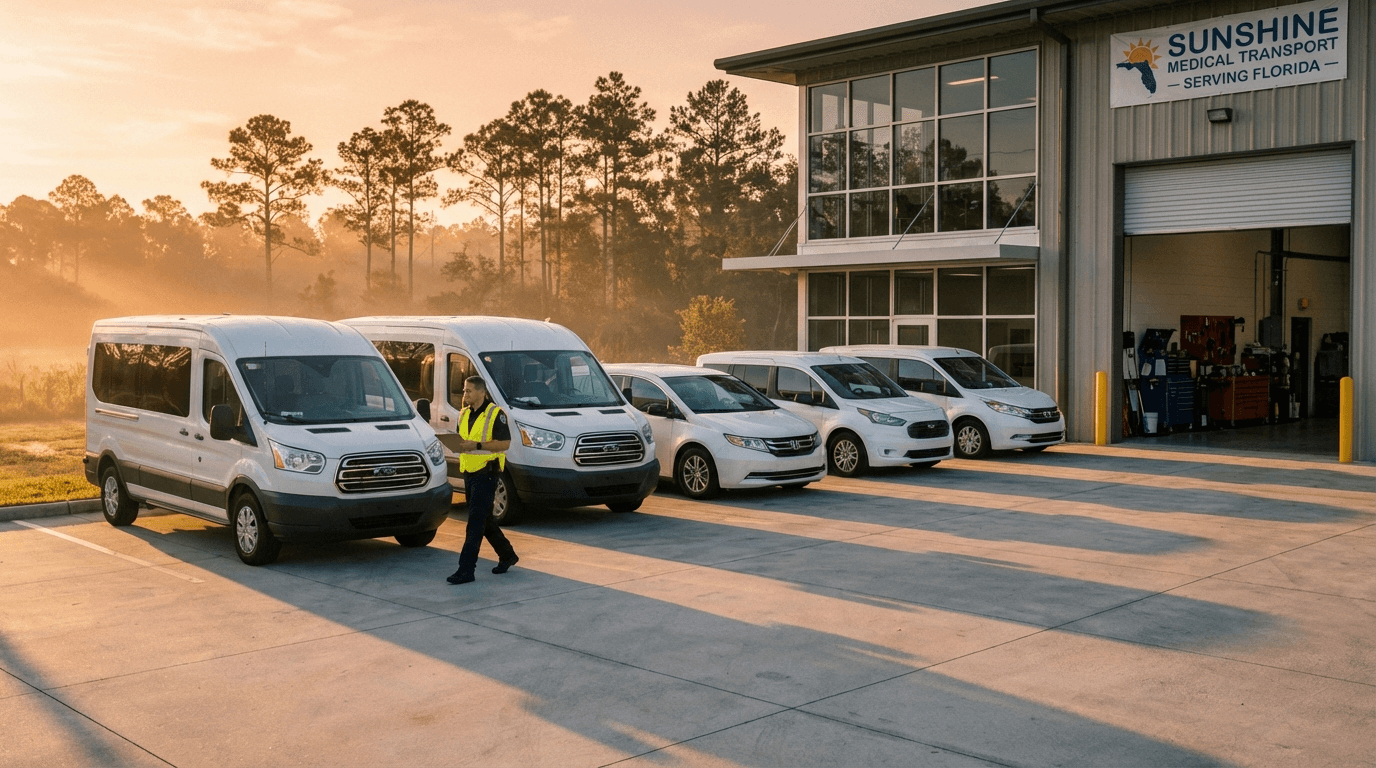
Wheelchair-accessible vans form the cornerstone of NEMT fleets, featuring specialized modifications to safely transport passengers who use wheelchairs or mobility scooters. These vehicles come equipped with essential features like hydraulic or electric lifts, secure wheelchair tie-downs, non-slip flooring, and safety restraint systems to ensure passenger stability during transit.[18]
The vans include wide entry doors, increased headroom, and lowered floors to accommodate various mobility devices while maintaining passenger comfort.[19] Beyond basic accessibility features, these vehicles incorporate handrails, adequate lighting, and spacious interiors that allow caregivers to assist patients during loading and unloading.[20]
Ambulatory transportation represents the most common and basic form of NEMT service, designed for patients who can walk independently or require minimal assistance but cannot drive themselves.[21] These services cater to individuals who face transportation barriers due to vision problems, medication restrictions, cognitive impairments, lack of vehicle access, or inability to afford traditional transportation options.[5]
Ambulatory vehicles feature low floors and high tops to facilitate easy entry and exit, making them ideal for patients who don’t require specialized medical equipment during transit.[22] The service typically uses standard sedans or passenger vehicles operated by drivers trained in basic patient assistance, offering a cost-effective solution for healthcare facilities and patients while maintaining essential mobility access.[21]
For NEMT providers, ambulatory services often serve as an entry point into the industry, with many operators starting with personal vehicles before expanding to more specialized transport options.[5]
Stretcher and gurney transport requires specialized vehicles and highly trained drivers to safely move patients who cannot sit upright or transfer to wheelchairs. NEMT drivers must complete comprehensive training on proper use of stretcher lifts, security straps, and safe patient transfer techniques.[23]
This includes learning correct procedures for moving stretchers and gurneys while patients are secured, as well as understanding how to operate vehicle-mounted safety equipment.[24] Drivers also need expertise in conducting thorough pre-trip safety checks of all stretcher-related hardware, restraint systems, and lift mechanisms to ensure reliable operation.[24]
Bariatric transport services address the specialized needs of patients weighing over 400 pounds, requiring unique vehicles and equipment for safe, comfortable transit.[26] These vehicles feature wider doorways, reinforced seating systems, and hydraulic lifts rated for higher weights to ensure proper patient accommodation.[27]
The equipment includes heavy-duty stretchers, specialized mattresses designed to prevent skin breakdown, and pressure-relieving support systems that can handle weights ranging from 300 to over 1,000 pounds.[27] Beyond equipment considerations, bariatric transport services employ personnel specifically trained in safe handling techniques, emergency response, and compassionate patient care to maintain dignity throughout the journey.[27]
This specialized transport proves essential for various medical needs, from routine appointments to hospital transfers, with costs typically ranging from $200 to $1,200 per trip depending on distance and equipment requirements.[27] Proper bariatric transport helps prevent complications like pressure sores, respiratory distress, and circulation problems that can occur during transit when using inadequately equipped vehicles.[28]
Effective onboarding software selection starts with a thorough assessment of your
organization’s unique requirements and constraints.
Modern NEMT providers are shifting from manual scheduling to digital platforms that streamline operations and improve service reliability.[29] These platforms feature user-friendly interfaces accessible across desktop and mobile devices, enabling dispatchers to make instant schedule changes as requests or cancellations occur.[29]
The software automates trip assignments by considering factors like driver availability, vehicle capacity, and proximity to pickup locations while integrating with GPS technology for real-time tracking.[29] Essential features include HIPAA-compliant security measures, automated billing systems, and integration with Electronic Health Records (EHR).[29]
Real-time GPS tracking has become essential for modern NEMT operations, enabling providers to monitor vehicle locations, optimize routes, and enhance service reliability.[32] This technology integrates GPS tracking systems with web platforms and mobile applications, providing live visibility into ride status and vehicle positioning.[32]
Mobile applications have transformed NEMT service delivery by creating seamless connections between patients, drivers, and healthcare providers.[34] These apps streamline booking and scheduling through user-friendly interfaces that allow easy entry of patient information, appointment times, and special transportation needs.[34]
Data analytics has become a cornerstone for improving NEMT service delivery and operational efficiency.[36] Providers leverage advanced reporting and analytics to gain insights into agent performance, call volumes, and customer satisfaction, thereby driving improvements and training programs.[36]
Automated onboarding processes can lead to 69% higher employee retention over three
years compared to traditional methods.
NEMT services demonstrate clear impact on reducing missed medical appointments, with meta-analyses showing a 37% decrease in no-shows when transportation assistance is available.[6] This improvement is critical for vulnerable populations and drives significant cost savings by preventing complications and emergency care needs.[38]
For some patients, such as those requiring dialysis, NEMT services can be the difference between life-sustaining treatment and missed appointments.[39]
NEMT services generate substantial cost savings for both healthcare systems and patients. Traditional NEMT programs save Medicaid approximately $4 billion annually by preventing delayed care and reducing emergency department visits.[7]
Modern NEMT solutions, which leverage digital technology, can achieve further savings of $268 per user annually,[8] contributing to industry-wide savings of up to $537 million.[8]
Patient satisfaction metrics consistently show that reliable NEMT services not only improve healthcare access but also enhance overall patient experience. Patients feel empowered and less burdened financially and emotionally, leading to better provider relationships and continuity of care.[40]
A Medicare Next Generation ACO study showed that NEMT participation increased outpatient visits by 9.2 per person annually, even though it did not significantly reduce emergency visits.[40] Another analysis of over 43,000 members across five states demonstrated lower average care costs among NEMT users, especially in minority populations.[41]
Effective onboarding software selection starts with a thorough assessment of your
organization’s unique requirements and constraints.
Federal regulations require state Medicaid agencies to ensure necessary transportation for beneficiaries. The Centers for Medicare & Medicaid Services have issued guidance consolidating federal requirements and state flexibilities to ensure efficient, compliant service delivery.[42]
While traditional Medicare has limited coverage for NEMT, many Medicare Advantage plans include supplemental benefits for transportation, and private insurance may offer diverse options to cover NEMT services.[3]
NEMT providers must navigate varying state-specific regulations regarding vehicle standards, driver qualifications, and service delivery protocols. Adherence to federal guidelines while customizing services to local requirements is essential for maintaining operational licenses.[45]
Combating fraud in NEMT involves robust software systems for verifying patient eligibility and completed trips through GPS tracking and claim audits. Strict driver credentialing and regular audits help safeguard the integrity of NEMT networks.[47]
Automated onboarding processes can lead to 69% higher employee retention over three
years compared to traditional methods.
Top-tier NEMT providers are characterized by reliability, comprehensive safety protocols, and compassionate service. They employ efficient scheduling systems to reduce wait times and emphasize HIPAA compliance and regular driver training.[49]
Robust background checks, regular Motor Vehicle Record (MVR) reviews, and mandatory certifications (CPR, PASS, etc.) ensure that drivers meet the necessary standards for safe patient transport.[50]
Maintaining a reliable vehicle fleet requires strict adherence to preventive maintenance schedules and regular inspections to ensure specialized equipment (like wheelchair lifts and ramps) is functioning safely.[54]
Effective NEMT providers offer robust customer service channels, real-time trip tracking, and proactive communication to ensure timely and reliable patient transportation while addressing unique accessibility needs.[55]
Effective onboarding software selection starts with a thorough assessment of your
organization’s unique requirements and constraints.
NEMT services are essential for bridging gaps in healthcare by ensuring patients access necessary medical appointments despite transportation challenges. They reduce missed appointments and ultimately contribute to better health outcomes.[7]
The industry is rapidly evolving with advancements in artificial intelligence, IoT, and telematics, promising more efficient, cost-effective, and patient-centered NEMT solutions. Innovative models like autonomous vehicles and integrated ride-sharing platforms are on the horizon.[57][58]
Healthcare organizations can improve patient outcomes by implementing comprehensive NEMT programs. Immediate steps include conducting needs assessments, leveraging technology for route optimization, and partnering with innovative providers like MediDrive to enhance accessibility and control costs.[59][60][61]
By addressing transportation barriers head on, organizations can ensure that patients receive timely care—ultimately driving better health outcomes and fostering a more equitable healthcare system. Get In Touch for more information.
Key Takeaways
Lorem ipsum dolor sit amet consectetur. Id purus tortor ac quam. Eu nibh aliquet at curabitur cras tristique. Viverra ornare. Lorem ipsum dolor sit amet consectetur. Id purus tortor ac quam. Eu nibh aliquet at curabitur cras tristique. Viverra ornare.
References
Delivered to your inbox — compliance updates, industry news, and best practices.