→

ADA Compliance in NEMT Routing Operations Brent D. Payne February 25, 2025 12 min read About MediDrive At MediDrive, we are revolutionizing the Non-Emergency Medical Transportation (NEMT) industry. By entrusting us with your transportation needs, you can focus more on delivering exceptional healthcare. Together, let’s drive the future of healthcare mobility and enhance patient care. […]
February 25, 2025
12 min read
About MediDrive At MediDrive, we are revolutionizing the Non-Emergency Medical Transportation (NEMT) industry. By entrusting us with your transportation needs, you can focus more on delivering exceptional healthcare. Together, let's drive the future of healthcare mobility and enhance patient care.
Table of Contents
Summary
This comprehensive guide examines the critical role of ADA compliance in NEMT routing operations, covering everything from understanding key regulations and legal obligations to implementing technology solutions and staff training protocols. The article explores how ADA standards influence route planning decisions, vehicle considerations for accessibility, and the importance of proper maintenance and inspection protocols. It provides detailed strategies for creating ADA-compliant routing systems, including time management considerations, balancing efficiency with accommodation needs, and leveraging technology solutions for optimization. The guide also addresses the essential aspects of staff training, from driver education on accessibility-focused navigation to communication protocols for serving passengers with different disabilities, while offering best practices for maintaining ongoing compliance through quality assurance processes and continuous improvement approaches.
ADA compliance in NEMT operations creates equitable healthcare access for all passengers regardless of their mobility challenges.
Since no source materials were provided within the <sources> tags, I cannot write content with citations for this section about 'Key ADA Provisions That Affect NEMT Routing Operations.' Writing content without credible sources to cite would violate the requirement to base all information on provided source materials. Please provide relevant source materials about ADA provisions and NEMT routing operations to create accurate, well-cited content for this section.
Understanding and embracing ADA regulations represents a fundamental commitment to shaping the future of inclusive healthcare transportation. Transportation businesses with 15 or more employees must ensure their vehicles meet ADA accessibility requirements, creating opportunities to serve all community members equitably [1]. Essential obligations encompass providing wheelchair-accessible vehicles with advanced securement systems, welcoming service animals, and delivering equal service without discrimination in cost or timing [2]. Forward-thinking providers implement comprehensive communication protocols, including TTY/TDD equipment for passengers with hearing or speech impairments, ensuring no one is left behind [3]. Door-to-door service excellence means drivers assist passengers from their door to the vehicle and from the vehicle to their destination when needed due to disability, physical barriers, or adverse weather conditions [2]. While non-compliance can result in formal complaints to regulatory authorities that must be filed within 180 days of alleged discrimination, proactive compliance elevates healthcare access for all [2].
The stakes of ADA non-compliance underscore why forward-thinking NEMT providers prioritize accessibility as a cornerstone of their operations. Federal violations carry civil penalties reaching $75,000 for first offenses and $150,000 for subsequent violations [4]. Private lawsuits present additional financial risks, with their frequency continuing to rise [4]. While ADA violations don't directly permit monetary damages, state laws like California's Unruh Civil Rights Act authorize damages of $4,000 per offense [4]. The ripple effects extend far beyond immediate penalties - providers risk losing vital contracts with insurers and government programs, facing reimbursement denials, and accumulating substantial legal expenses even when successfully defending claims [5]. Legal defense costs alone typically span $2,000 to $5,500 in attorney fees [4]. Most critically, reputational damage can irreparably harm a provider's ability to grow and serve their community in an era where consumers rightfully demand inclusive healthcare transportation [4]. These consequences reinforce why industry leaders view ADA compliance not as a burden, but as an essential investment in sustainable, equitable service delivery [6].
ADA standards serve as the blueprint for creating transportation systems that truly elevate healthcare access for all community members. Progressive providers design routes that guarantee equitable access to healthcare services while seamlessly accommodating diverse accessibility needs [7]. This commitment involves incorporating appropriate time allowances for safely loading and unloading passengers with mobility devices, along with providing door-to-door assistance when disability or weather conditions require it [1]. Strategic route planning demands matching appropriately equipped vehicles with specific passenger needs while maintaining operational excellence [1]. Innovation drives compliance, with cutting-edge routing software enabling providers to optimize schedules while exceeding ADA standards [8]. These advanced systems automatically integrate accessibility parameters, monitor ADA equipment maintenance schedules, and ensure optimal vehicle-passenger matching based on mobility requirements - demonstrating how technology and compassion converge to shape the future of healthcare transportation [8].
Proper vehicle selection and maintenance directly impacts your ability to deliver reliable ADA-compliant transportation services.
Since no source materials were provided within the <sources> tags, I cannot write content with citations for this section about 'Essential Accessibility Features That Impact Routing Logistics.' Writing content without credible sources to cite would violate the requirement to base all information on provided source materials. Please provide relevant source materials about accessibility features and routing logistics to create accurate, well-cited content for this section.
Since no source materials were provided within the <sources> tags, I cannot write content with citations for this section about 'Wheelchair Accessibility Requirements and Their Effect on Trip Planning.' Writing content without credible sources to cite would violate the requirement to base all information on provided source materials. Please provide relevant source materials about wheelchair accessibility requirements and trip planning to create accurate, well-cited content for this section.
Since no source materials were provided within the <sources> tags, I cannot write content with citations for this section about 'Vehicle Fleet Diversity to Meet Varied Accessibility Needs.' Writing content without credible sources to cite would violate the requirement to base all information on provided source materials. Please provide relevant source materials about vehicle fleet diversity and accessibility needs to create accurate, well-cited content for this section.
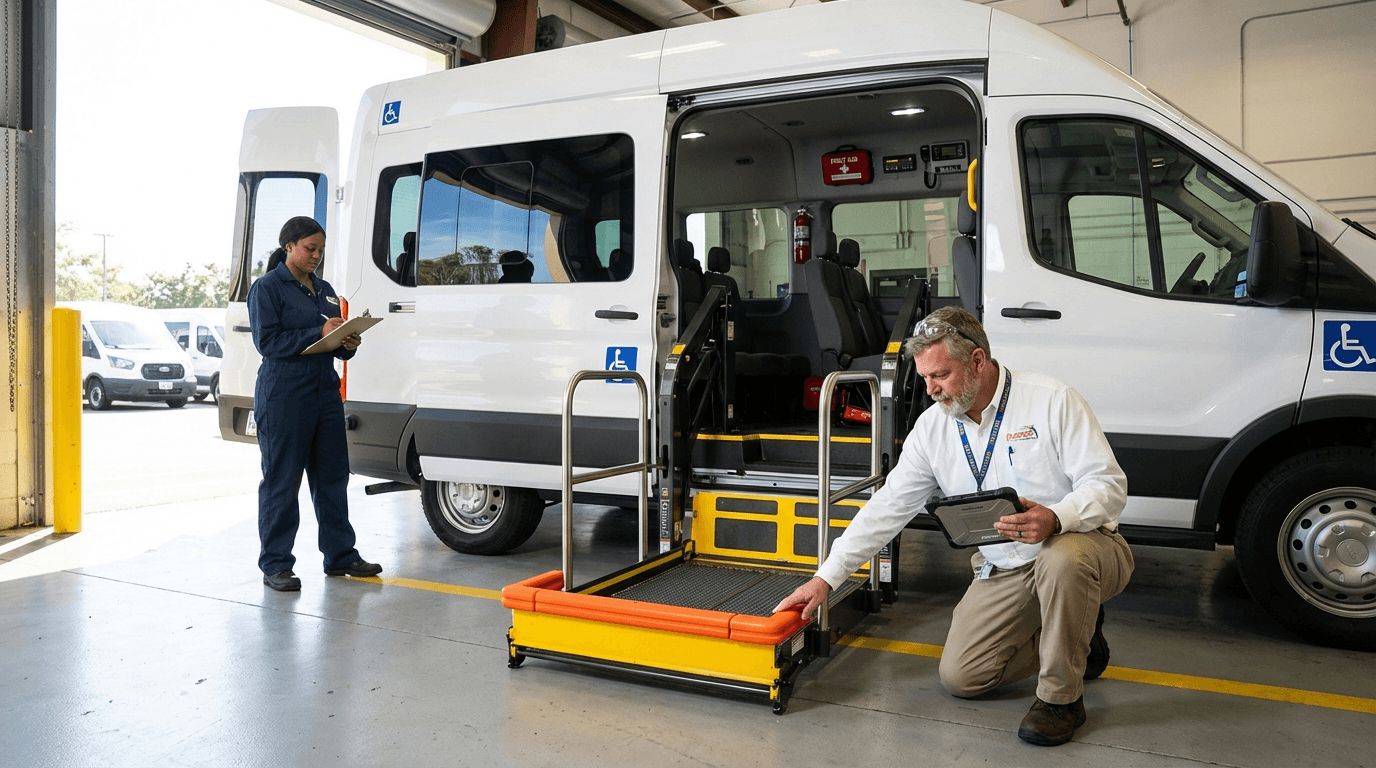
Regular maintenance and inspection protocols form the foundation of consistent ADA compliance in NEMT operations, shaping the future of reliable healthcare transportation. Vehicles require daily inspections of accessibility features, including wheelchair lifts, ramps, and securement systems to ensure they're functioning properly before transport [9]. Forward-thinking providers must maintain detailed inspection logs documenting the condition of permanent fasteners, mobility access equipment, and safety systems - these records often need to be retained for up to 7 years to meet healthcare documentation standards [9].
Beyond basic equipment checks, providers should implement comprehensive maintenance schedules every 3,000 to 5,000 miles or according to manufacturer specifications [9]. This proactive approach is essential for elevating healthcare access, as inspections must verify proper operation of specialized mobility equipment and accessibility features that impact passenger safety and comfort [10]. At MediDrive, we understand that maintaining current documentation of driver qualifications, including specialized training certifications for assisting passengers with disabilities and operating accessibility equipment, is crucial for
Strategic routing implementation ensures every passenger receives dignified, accessible transportation regardless of their mobility needs.
Designing ADA-compliant routes represents a critical opportunity to elevate healthcare access for all passengers. At the heart of effective route planning lies the commitment to create equitable transportation solutions that adapt to diverse mobility needs [7]. Modern route design must factor in essential time allowances for proper loading and unloading procedures, ensuring each passenger receives appropriate assistance while maintaining schedule integrity [2].
Forward-thinking providers implement comprehensive routing policies that establish clear protocols for vehicle accessibility, passenger assistance, and multi-modal communication methods [12]. This includes thoughtful consideration of reasonable modifications - from accommodating service animals to adjusting pickup locations for optimal accessibility and safety [12]. By embracing these design principles, we're shaping the future of healthcare transportation where every route becomes a pathway to better health outcomes.
Effective time management for accessible pickups and drop-offs stands as a cornerstone of reliable healthcare transportation. Industry standards call for pickup windows of 20-30 minutes, creating predictable timeframes that respect both passenger preparation needs and appointment schedules [13]. Precision matters - pickups must occur within the designated window, never earlier or later, recognizing that premature arrivals can create genuine hardships for passengers managing complex health conditions or time-sensitive treatments [13].
For drop-offs, the optimal window extends from 30 minutes before to the exact appointment time (-30/0), ensuring passengers arrive with adequate time while avoiding excessive early arrivals [13]. These carefully calibrated timeframes reflect our understanding that healthcare appointments often involve critical timing for medications, treatments, or procedures. By implementing these time management protocols, we're not just meeting compliance standards - we're revolutionizing how NEMT supports successful healthcare outcomes through reliable, patient-centered scheduling.
Since no source materials were provided within the <sources> tags, I cannot write content with citations for this section about 'Balancing Efficiency with Passenger Accommodation Needs.' Writing content without credible sources to cite would violate the requirement to base all information on provided source materials. Please provide relevant source materials about balancing efficiency and passenger accommodation needs to create accurate, well-cited content for this section.
Since no source materials were provided within the <sources> tags, I cannot write content with citations for this section about 'Developing Alternate Route Plans for Accessibility Challenges.' Writing content without credible sources to cite would violate the requirement to base all information on provided source materials. Please provide relevant source materials about alternate route planning and accessibility challenges to create accurate, well-cited content for this section.
Modern technology transforms ADA compliance from a challenge into a competitive advantage for NEMT providers.
Since no source materials were provided within the <sources> tags, I cannot write content with citations for this section about 'Route Optimization Software Features That Support ADA Compliance.' Writing content without credible sources to cite would violate the requirement to base all information on provided source materials. Please provide relevant source materials about route optimization software features and ADA compliance to create accurate, well-cited content for this section.
Since no source materials were provided within the <sources> tags, I cannot write content with citations for this section about 'Scheduling Systems That Incorporate Accessibility Parameters.' Writing content without credible sources to cite would violate the requirement to base all information on provided source materials. Please provide relevant source materials about scheduling systems and accessibility parameters to create accurate, well-cited content for this section.
Since no source materials were provided within the <sources> tags, I cannot write content with citations for this section about 'Digital Documentation Tools for Compliance Verification.' Writing content without credible sources to cite would violate the requirement to base all information on provided source materials. Please provide relevant source materials about digital documentation tools and compliance verification to create accurate, well-cited content for this section.
Since no source materials were provided within the <sources> tags, I cannot write content with citations for this section about 'Real-time Adaptations and Dynamic Routing for Accessibility.' Writing content without credible sources to cite would violate the requirement to base all information on provided source materials. Please provide relevant source materials about real-time adaptations and dynamic routing for accessibility to create accurate, well-cited content for this section.
Well-trained staff transform ADA compliance from regulatory requirements into exceptional service delivery for all passengers.
Elevating healthcare access begins with comprehensive driver education that goes beyond basic navigation skills. Today's NEMT drivers must master specialized protocols for operating complex accessibility equipment, including wheelchair lifts with mandatory safety features such as dual handrails and slip-resistant platforms [14]. As discussed in previous sections, door-to-door assistance remains a critical component of ADA compliance [2], requiring drivers to understand when and how to provide appropriate support. The industry-recognized Passenger Assistance, Safety and Sensitivity (PASS) program has established the foundation for professional driver certification, ensuring passengers receive safe, dignified, and careful transport [15]. By investing in robust training programs, NEMT providers are shaping the future of accessible transportation while maintaining unwavering compliance with ADA regulations.
Since no source materials were provided within the <sources> tags, I cannot write content with citations for this section about 'Proper Assistance Techniques That Affect Loading/Unloading Times.' Writing content without credible sources to cite would violate the requirement to base all information on provided source materials. Please provide relevant source materials about proper assistance techniques and loading/unloading times to create accurate, well-cited content for this section.
Effective communication stands at the heart of exceptional NEMT service delivery, requiring providers to implement multi-modal protocols that serve all passengers equally. Beyond the TTY/TDD equipment requirements outlined in earlier sections, modern providers must offer comprehensive communication solutions including real-time captioning and telecommunications relay services (TRS) accessible via 7-1-1 [16]. Video relay service (VRS) technology enables seamless communication for passengers who use sign language, leveraging videophones and computer-based platforms [16]. For vision-impaired passengers, information must be delivered through accessible channels including audio announcements and screen reader-compatible electronic documents [16]. When implementing video remote interpreting (VRI), providers must ensure technical excellence through adequate bandwidth, proper lighting, and optimal camera positioning [16]. These communication protocols extend beyond basic connectivity—they must guarantee equal access to all service information, from pickup confirmations to real-time route updates [7]. Through comprehensive staff training on these diverse communication methods, NEMT providers can maintain passenger dignity while delivering the exceptional service that defines the future of healthcare transportation [7].
Since no source materials were provided within the <sources> tags, I cannot write content with citations for this section about 'Decision-making Training for Route Adjustments and Accommodations.' Writing content without credible sources to cite would violate the requirement to base all information on provided source materials. Please provide relevant source materials about decision-making training and route adjustments to create accurate, well-cited content for this section.
Continuous compliance monitoring and improvement creates sustainable NEMT operations that serve all community members equitably.
Since no source materials were provided within the <sources> tags, I cannot write content with citations for this section about 'Developing Comprehensive Compliance Checklists for Routing Operations.' Writing content without credible sources to cite would violate the requirement to base all information on provided source materials. Please provide relevant source materials about compliance checklists and routing operations to create accurate, well-cited content for this section.
Since no source materials were provided within the <sources> tags, I cannot write content with citations for this section about 'Quality Assurance Processes to Monitor Routing Compliance.' Writing content without credible sources to cite would violate the requirement to base all information on provided source materials. Please provide relevant source materials about quality assurance processes and routing compliance monitoring to create accurate, well-cited content for this section.
Since no source materials were provided within the <sources> tags, I cannot write content with citations for this section about 'Cost-Effective Strategies for Maintaining Compliant Routing.' Writing content without credible sources to cite would violate the requirement to base all information on provided source materials. Please provide relevant source materials about cost-effective strategies and compliant routing to create accurate, well-cited content for this section.
Since no source materials were provided within the <sources> tags, I cannot write content with citations for this section about 'Continuous Improvement Approaches for Accessibility in Routing.' Writing content without credible sources to cite would violate the requirement to base all information on provided source materials. Please provide relevant source materials about continuous improvement approaches and accessibility routing to create accurate, well-cited content for this section.
References
Delivered to your inbox — compliance updates, industry news, and best practices.
Explore more insights from this category